Top Advantages of Infrastructure as Code
Infrastructure as Code, often shortened to IaC, turns infrastructure setup into a repeatable, reviewable, automated process. Instead of relying on manual console clicks, handwritten runbooks, or one-off scripts, teams define cloud infrastructure and configuration in code that can be versioned, tested, reused, and deployed through pipelines. The result is a more reliable way to manage environments, reduce drift, and support faster delivery without sacrificing control.
For organizations managing modern applications, the benefits of infrastructure as code go beyond speed. IaC improves configuration management, strengthens collaboration between development and operations, and creates a practical foundation for infrastructure optimization across development, staging, and production.
What makes Infrastructure as Code so valuable?
Infrastructure as Code is valuable because it replaces fragile manual processes with consistent, code-driven automation. Teams can define servers, networks, databases, storage, permissions, and other infrastructure components in files, then use tools to provision and update those resources predictably. That shift makes infrastructure easier to understand, easier to audit, and easier to recreate when something changes or fails.
The real advantage is not simply “automation.” It is the combination of automation, documentation, repeatability, and governance. When infrastructure lives in code, every change can be reviewed before it is applied, tracked after it is deployed, and reused when a team needs another environment. This creates a cleaner operating model for fast-moving teams that still need stability.
Manual infrastructure creates hidden risk
Traditional infrastructure management often depends on people remembering the right sequence of steps. One engineer may configure a staging environment slightly differently from production. Another may patch a setting directly in the cloud console during an urgent fix. Over time, these small differences create configuration drift, where environments no longer match the intended design.
That drift is more than a technical nuisance. It can cause tests to pass in one environment and fail in another, make incidents harder to troubleshoot, and leave security settings inconsistent. Manual work also slows teams down because every new environment requires coordination, waiting, and verification.
IaC addresses these problems by making the desired state explicit. The code becomes the source of truth for what should exist, how it should be configured, and how changes should be introduced.
The core infrastructure as code benefits
The strongest infrastructure as code benefits show up where speed, consistency, and reliability intersect. Teams can provision resources faster, but they can also do it with more confidence because the process is standardized.
Key benefits include:
- Faster provisioning: New environments can be created from reusable templates instead of manual setup steps.
- Improved consistency: Development, staging, and production can be built from the same definitions, reducing surprise differences.
- Reduced human error: Automated execution limits mistakes caused by missed steps, typos, or inconsistent console changes.
- Better collaboration: Infrastructure changes can be reviewed in the same way application code is reviewed.
- Clearer audit trails: Version control shows who changed what, when, and why.
- Easier recovery: If infrastructure needs to be recreated, the code provides a repeatable blueprint.
- Stronger governance: Security and compliance rules can be embedded into workflows rather than checked manually at the end.
These benefits of infrastructure as code make it especially useful for teams that release frequently, operate across multiple environments, or manage complex cloud infrastructure.
Configuration management becomes more consistent
Configuration management is one of the clearest areas where IaC improves day-to-day operations. Instead of documenting settings in a wiki and hoping every environment follows them, teams define the configuration directly in code. That code can specify resource sizes, network rules, dependencies, operating system packages, access controls, and service settings.
This helps teams avoid the familiar “it works on my machine” problem at the infrastructure level. If the same configuration definition is applied across environments, teams can trust that staging is a closer reflection of production. Testing becomes more meaningful, deployments become less risky, and troubleshooting becomes more focused.
IaC also preserves operational knowledge. When infrastructure exists only in the heads of a few specialists, the organization is exposed to delays and knowledge gaps. When configuration is captured in code, new team members can inspect the current state, understand patterns, and propose changes through a structured workflow.
How does IaC improve DevOps and CI/CD?
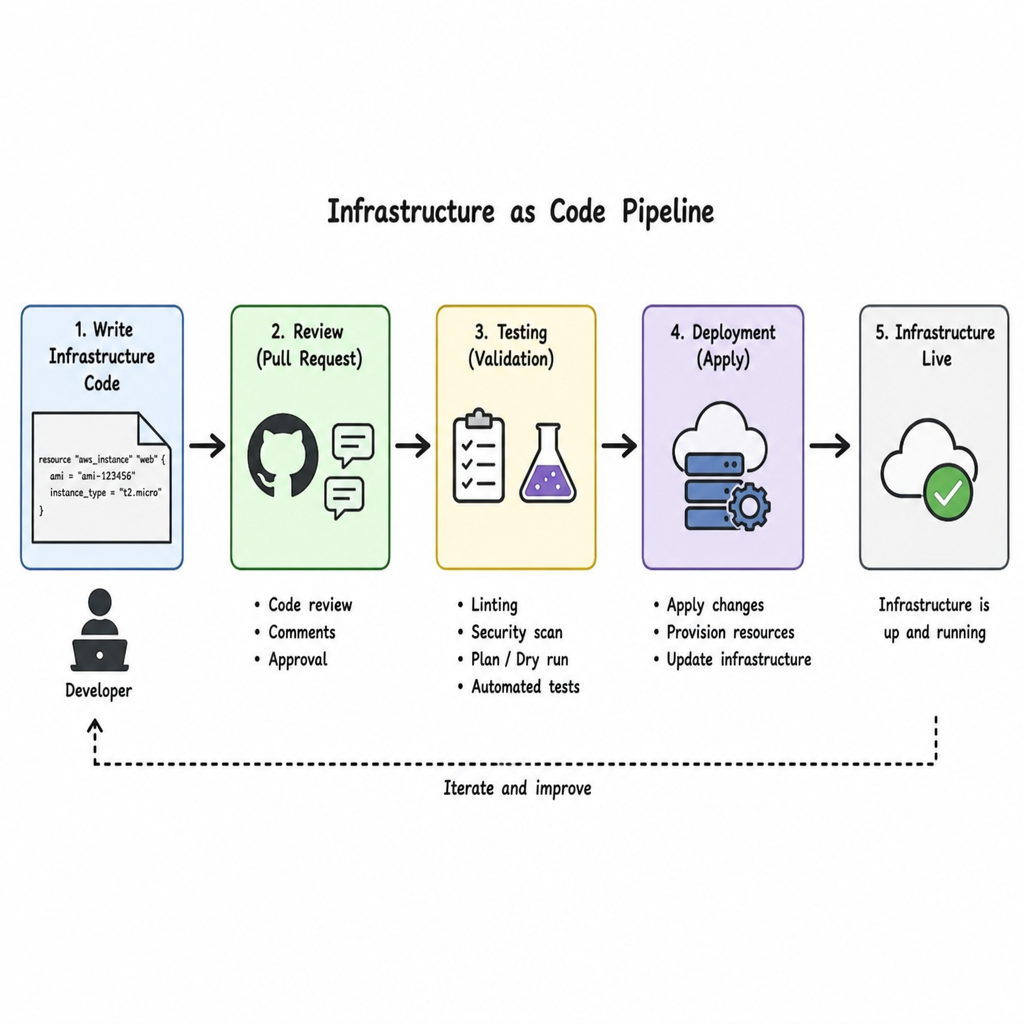
IaC improves DevOps by allowing infrastructure changes to move through the same disciplined process as application changes. Teams can store infrastructure definitions in version control, trigger automated checks, request peer review, and deploy approved changes through CI/CD pipelines. This supports important devops benefits such as faster feedback, shared ownership, and more predictable releases.
In a mature workflow, a developer or platform engineer can propose an infrastructure change with a pull request. Automated tests can validate formatting, security rules, dependencies, and policy requirements before the change reaches production. Once approved, the pipeline applies the update in a controlled way.
This approach reduces handoffs between development and operations. Instead of filing a ticket and waiting for manual provisioning, teams can collaborate around code. Operations teams still maintain guardrails and standards, but delivery teams gain a clearer and faster path to the infrastructure they need.
Infrastructure automation accelerates delivery
Infrastructure automation is one of the most practical reasons teams adopt IaC. Repetitive tasks such as creating networks, deploying databases, assigning permissions, or cloning environments can be automated from tested definitions. This allows teams to focus less on setup and more on shipping reliable software.
Automation also makes temporary environments more realistic. A team working on a feature branch may need an environment that closely mirrors production for testing. With IaC, that environment can be created from approved modules, used for validation, and removed when no longer needed. This supports faster experimentation without leaving unmanaged resources behind.
For disaster recovery and high availability planning, IaC provides another advantage. If resources need to be recreated in another region or account, infrastructure definitions give teams a starting point that is far more reliable than memory or outdated documentation.
IaC supports better infrastructure optimization
Infrastructure optimization is not only about reducing cost. It is about matching resources to actual needs while keeping performance, reliability, and security in balance. IaC helps because infrastructure definitions make resource choices visible and reviewable.
When teams can see instance sizes, storage settings, scaling rules, and environment patterns in code, they can discuss whether those choices still make sense. Overprovisioned development environments become easier to spot. Unused resources can be tied to automated cleanup processes. Standard modules can guide teams toward approved, right-sized patterns rather than custom builds every time.
IaC also supports forecasting and planning. Because infrastructure is defined in reusable components, teams can estimate the impact of creating new environments or expanding services with more clarity. This is especially helpful in cloud infrastructure, where small unmanaged decisions can accumulate into unnecessary spend.
A practical optimization checklist might include:
- Use reusable modules for common infrastructure patterns.
- Add tags or labels for ownership, environment, and cost tracking.
- Automate teardown for short-lived test environments.
- Review resource sizes during code review, not only after deployment.
- Build policies that prevent risky or wasteful configurations from being applied.
Security and compliance become part of the workflow
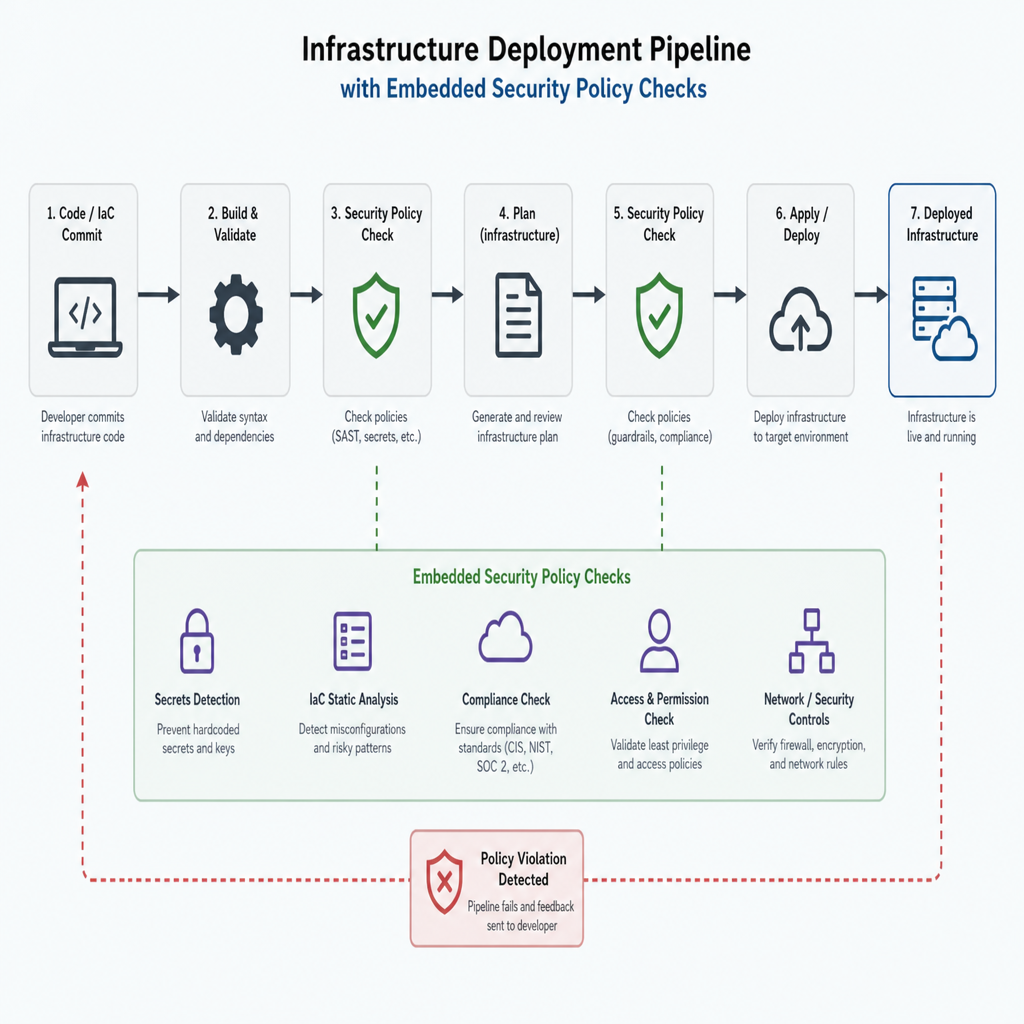
IaC makes security stronger when it is paired with the right review and policy process. Security teams can define approved patterns for networks, identity, encryption, logging, and access control, then make those patterns reusable. Instead of checking every setting manually after deployment, teams can prevent many unsafe configurations before they reach production.
Policy as code extends this idea. Rules can be written to detect issues such as public storage, overly broad permissions, missing encryption, or nonstandard network exposure. These checks can run automatically in the pipeline, giving teams immediate feedback while changes are still easy to fix.
This does not eliminate the need for security expertise. It makes that expertise easier to apply consistently. The practical benefit is a smoother relationship between speed and control: teams can move quickly while still operating inside defined guardrails.
Declarative and imperative approaches both have a place
Infrastructure as Code (IaC) tools typically use either a declarative or imperative model. The declarative approach focuses on the final outcome, where you define the target state and let the tool handle the provisioning steps. Conversely, the imperative approach requires you to script the exact, step-by-step instructions needed to configure the environment.
Declarative IaC is often preferred for cloud infrastructure provisioning because it is easier to reason about the intended state. If the code says a network, database, and compute service should exist with specific settings, the tool compares reality against that definition and applies the necessary changes.
Imperative approaches can still be useful when the order of operations matters or when teams need procedural control over configuration tasks. The right choice depends on the use case, team skills, and the level of control required.
A simple comparison:
| Approach | Best for | Main advantage | Watch out for |
|---|---|---|---|
| Declarative | Provisioning repeatable infrastructure | Clear desired state and easier maintenance | Requires understanding how the tool calculates changes |
| Imperative | Step-by-step configuration tasks | Fine control over execution order | Can become harder to maintain as complexity grows |
Choosing the right IaC tools
Tool selection should start with the environment and the job to be done. Some tools are stronger for provisioning cloud infrastructure, while others are better suited to configuration management across servers and applications. Teams should also consider whether they operate in one cloud, multiple clouds, hybrid infrastructure, or a highly regulated environment.
Common options include Terraform, Ansible, Puppet, Chef, AWS CloudFormation, and Azure Resource Manager. Terraform is widely used for declarative, cloud-agnostic provisioning. Ansible is known for agentless automation and readable YAML-based playbooks. Cloud-native options can be a strong fit when an organization is deeply committed to one provider’s ecosystem.
Useful selection criteria include:
- Infrastructure scope: Single cloud, multi-cloud, hybrid, or on-premises.
- Primary use case: Provisioning, configuration management, compliance enforcement, or all three.
- Team skill set: Preferred language, workflow familiarity, and operational maturity.
- Integration needs: CI/CD tools, version control, secrets management, and policy checks.
- Governance requirements: Audit trails, approvals, role-based access, and reusable standards.
The best tool is not always the most powerful one. It is the one the team can use consistently, safely, and repeatedly.
Best practices for successful adoption
IaC works best when teams treat it as a long-term operating model rather than a one-time automation project. The code needs structure, ownership, review, and maintenance just like application code.
Start with version control. Every infrastructure change should be traceable, reviewable, and reversible where possible. Use modules or reusable components to prevent every team from solving the same problem differently. Add automated tests and policy checks early so quality does not depend entirely on manual review.
Strong practices include:
- Keep infrastructure code in version control with clear review rules.
- Separate environments while reusing shared modules.
- Store secrets securely instead of hardcoding them in repositories.
- Run automated validation before applying changes.
- Use naming, tagging, and documentation standards.
- Prefer immutable infrastructure patterns where practical to reduce drift.
- Review existing infrastructure regularly so code and reality stay aligned.
Adoption may also require cultural change. Teams used to console-based fixes may need time to shift toward pull requests, pipelines, and automated approvals. Starting with a focused use case, such as standardizing development environments, can build confidence before expanding to more critical systems.
The lasting value of IaC
The top advantages of IaC come from making infrastructure repeatable, transparent, and easier to improve. It helps teams reduce manual errors, strengthen configuration management, speed up provisioning, and bring infrastructure work into the same collaborative flow as software delivery.
For modern teams, the question is not only whether IaC can make deployments faster. It is whether the organization wants a more reliable way to manage change. When infrastructure is defined in code, automation becomes safer, optimization becomes easier, and cloud infrastructure becomes a shared, governable system rather than a collection of manual decisions.
